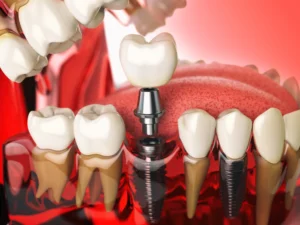
If you’re reading this, you’ve probably already lost a tooth or you’re about to. And what weighs on you most usually isn’t the procedure itself: it’s not knowing what you’re getting into. I’ve been placing implants for 38 years and I’ve treated more than 10,000 patients. In that time I’ve seen that the patient who understands their treatment is the one who does best. So this is what I explain to someone sitting in my office for the first time.
What a dental implant actually is
An implant is not a tooth. It’s a root. It’s a screw, generally made of titanium, that goes inside the bone and replaces the root you lost. On top of that root, the visible tooth — the crown — is screwed into place. They are two separate things, and it’s worth being clear about that from the start: when someone quotes you a price, you’ll want to know whether it includes both. What makes an implant work is a process called osseointegration: the bone grows around the titanium and bonds to it. It isn’t held there by pressure — it becomes integrated. That’s why a well-placed implant can last decades. And that’s also why the titanium matters, and the brand matters. We’ll get to that later.
Are you a candidate?
It’s the question I’m asked most, and the honest answer is: almost always yes, but not always in the same way. This is what I evaluate during an assessment:
How much bone you have. This is the determining factor. If you were once told you didn’t have enough bone, that diagnosis deserves a second look: today there are angulation techniques that take advantage of the areas of dense bone that remain, and long implants that anchor into the cheekbone when there’s nothing left up top. What was impossible twenty years ago often isn’t today.
The condition of your gums. If there’s active disease, it gets treated first. An implant needs healthy ground.
Your general health. Controlled diabetes, controlled hypertension, ongoing medical treatments: none of that is an absolute barrier. It’s coordinated with your physician and planned around. What does significantly compromise the prognosis is smoking.
Your availability for follow-up visits. An implant needs monitoring. If you know it will be hard for you to come back, let’s talk about it from the start and plan accordingly. Age, on the other hand, is almost never the problem. I’ve rehabilitated patients over 80 with excellent results.
What the treatment looks like, step by step
1. Assessment and diagnosis. Medical history, examination and 3D scan. Bone can’t be seen from the outside, so without a CT scan there’s no complete diagnosis.
2. Digital planning. On that scan we define where each implant goes, at what angle and at what depth. I show it to you on screen before I touch you. It isn’t a detail of the process: it’s what makes the surgery predictable.
3. Surgery. Under local anesthesia, guided by the plan. A single implant takes less time than people imagine.
4. Temporary teeth. Depending on the case, you leave the same day or within a few days with fixed temporary teeth. You don’t leave without teeth.
5. Integration. The bone integrates with the titanium. In a younger person it usually takes 3 to 4 months; after 65, 4 to 6.
6. Final prosthesis. It’s manufactured digitally from a scan of your mouth and screwed into place.
7. Follow-up. Every 4 to 6 months. This is where long-term durability is decided.
How much a dental implant costs in Bogotá
Here are the approximate ranges you’ll find, and then I’ll explain why they vary.
| Treatment | Approximate range |
|---|---|
| Single implant (with crown) | $3,500,000 – $6,000,000 COP |
| Full-arch rehabilitation (All-on-4 / Full Arch) | from $15,000,000 COP |
| Conventional removable denture | around $1,500,000 COP |
Why the price varies:
- The implant brand. A system with decades of scientific backing guarantees you something concrete: that ten years from now, if a screw needs replacing, the part still exists.
- Whether you need preparatory work. Extractions, gum treatment, regeneration.
- The training and experience of whoever performs the surgery.
- The planning technology. CT-guided surgery and a digitally manufactured prosthesis raise the cost of the process and improve the result. A note on price: in implantology, the cheapest option up front sometimes turns out to be the most expensive over ten years. I’m not telling you this to alarm you, but so that you compare with the same yardstick everywhere. I’d rather explain where your money goes and let you decide. The figures above are reference ranges and change from case to case. The exact value can only be given after an assessment with a CT scan.
Implant or removable denture: the ten-year math
Many people compare the price on day one. It’s worth comparing the price across the decade. A removable denture costs less at the start, but it gets adjusted, replaced, and replaced again. And there’s something worth knowing: the bone where your teeth used to be resorbs when
there’s no root stimulating it. Year after year. That’s why dentures stop fitting over time, and why the lower third of the face gradually collapses. The implant stops that process, because it gives the bone back the function it lost.
How long an implant lasts
- With proper care, decades. I have patients with implants working perfectly after many years. What makes an implant fail is almost never the implant itself. It’s what happens around it:
- Peri-implantitis. Inflammation from plaque accumulation. It’s the leading cause of late failure.
- Smoking. It compromises healing and blood supply. It’s the most significant risk factor that is genuinely in your hands.
- Uncontrolled bruxism. Excessive forces on the prosthesis. It’s managed with a nightguard.
- Missed follow-ups. A problem caught in time is almost always solvable.
What to ask before deciding
1. Will I have a 3D CT scan before surgery? 2. What implant brand will you use, and why that one? 3. Does the price include the crown, or just the implant? 4. Will my prosthesis be screw-retained or cemented? 5. Who will perform the surgery, and what is their training in implantology? 6. What does the follow-up include? These are six reasonable questions and you have every right to ask them. The answers will help you compare options with real criteria.
A dental implant isn’t a cosmetic expense. It’s recovering the ability to chew, halting bone loss and supporting the structure of your face. If you’re evaluating implants in Bogotá and want an assessment with a real diagnosis, come in and let’s talk. I won’t operate on you that day, and I won’t ask you to decide anything in the office.
Frequently asked questions
Does placing an implant hurt? It’s done under local anesthesia and you won’t feel pain during surgery. Recovery is usually comparable to an extraction, with mild discomfort for two or three days. Will I be without teeth while it integrates? No. In the vast majority of cases we can place a fixed temporary. How long does the whole thing take? Between 3 and 6 months for the final prosthesis in a conventional case. In full rehabilitations with immediate loading, the timelines are different. Does insurance cover it? Most plans in Colombia don’t cover implants, or cover them partially. Check with your provider. Can I do it if I have diabetes? Yes, if it’s controlled. It’s coordinated with your treating physician.